
Before You Write Another Word
How to stop running on the content treadmill and actually get somewhere

Years ago, my first boss told me “It’s an odd feeling when you get off the treadmill. You feel disoriented. Your heart keeps pounding as your body stands still. But then, you feel the most unexpected calm.”
It’s something I’ve carried with me throughout the past 14 years, and it’s a truth I’ve seen illustrated throughout my work and entertainment—like movies.
Take The Devil Wears Prada, for example. Inspired by Anna Wintour, former Editor-in-Chief of Vogue, the film follows Andy Sachs—an ambitious journalist thrust into the world of high fashion when she lands an assistant role at the world’s most prestigious magazine.
It’s the opportunity of a lifetime, and Andy runs with it. Hard. She transforms her wardrobe, sacrifices her relationships, and bends herself into whatever her formidable boss, Miranda Priestly, needs her to be—all in service of an opportunity she never stopped to interrogate.
She’s on the treadmill from the first scene.

Until she finally steps off in Paris.
At the height of her fashion world “success,” Andy registers she’s been running toward a finish line she never stopped to question. She understands that chasing an opportunity for the sake of opportunity is an unwinnable game. She gets honest with herself about where she actually wants to be, and suddenly, every decision she’s been wrestling with becomes clear.
It’s a feeling most of us recognize, especially as a founder or CEO.
In today’s edition, I’ll break down why and how being more deliberate about where you’re going can save you months, if not years, of unnecessary struggle.
Every personal and professional journey has two fixed points: Point A is where you are now, Point B is where you’re going.
Point A is easy to define if you’re willing to give yourself a good hard look in the mirror. Point B demands the same honesty—but it’s harder to define because you’re trying to envision what doesn’t exist yet. Most founders have a vague sense of it at best, and that’s not their fault.
This is as true for content as it is for anything else. “I should be creating content” is not a Point B. Neither is “I want to build my brand” or “I want to create more opportunities.” These feel like answers but they function like non-answers. They’re the content equivalent of Andy taking the job at Runway magazine—a compelling opportunity, sure. But not a strategy.
Without a strategy, you end up exactly where Andy spent most of the film—reactive, exhausted, and making decisions from anxiety rather than intention. That energy comes through in your content. Viewers sense the difference between founders who know exactly where they’re taking them and those still figuring it out.
Clarity Is the Strategy
Inspired by Anna Wintour—the most powerful woman in fashion—Miranda Priestly is the most strategically clear person in The Devil Wears Prada. She runs Runway with an iron grip and almost supernatural sense of direction. Her clarity is what enables her to be so decisive, ruthless, and unflappable.
There’s a scene early in the film where Andy, still adjusting to the world of high fashion, makes the mistake of laughing at what she assumes is a trivial debate over two nearly identical blue belts.
Miranda stops her cold. In under two minutes, she reverse engineers the exact journey of the cerulean blue cardigan Andy’s wearing at that very moment—tracing it from a designer’s runway decision, to the pages of fashion magazines, to department store shelves, and finally to the discount bin where Andy unknowingly picked it up.
To Andy, the belts were barely distinguishable. To Miranda, the entire critical path was obvious. Decisions are easy when you always know where things are going.
That’s the energy founders are aiming for in their content. Not Miranda’s particular brand of terrifying—but that groundedness. The sense of someone who knows exactly what they’re building and why. People respect it.
The Framework
Getting there requires working at two levels—and asking the same type of question at both.
The Macro Level
What measurable outcome is your content is building toward? Not “build my brand,” but something observable enough that you’d know if it was working. How many inbound leads per month? What number of newsletter subscribers by what date? If you can’t point to it and say “that happened” or “that didn’t,” it’s not a Point B yet. A vague outcome puts you on an endless treadmill.
The Micro Level
What observable action do you want someone to take after viewing a particular post? Not “feel inspired,” but something you can actually track. “Subscribe to my newsletter. Download this lead magnet. Schedule a demo.” If you don’t know what you want someone to do, they won’t know either.
Same question, same rigour applied at different altitudes. When your individual posts (micro level) are consciously serving your macro outcome, content stops feeling like a treadmill and starts functioning as a strategy.
In learning design, we call this Backward Design—and it’s one of the first things I walk founders through when we start working together. Start with Point B, identify Point A, and then work backwards. What’s critical versus “nice to have” becomes obvious.
If you want to see Backward Design in practice, I made a video applying it to course creation—the principle translates directly to content:
Side note: This is a perfect example of evergreen content. I recorded this video nearly three years ago and it's still just as relevant today.
The Universal Point B
Every post you make, every framework you share, every insight you put into the world is building toward one thing: a direct line to your audience. Not likes. Not impressions. But the ability to reach your target audience directly in their inbox—without an algorithm deciding whether or not they see it.
Social media is rented visibility. An email list is owned real estate. Each post should move someone a step closer to that direct relationship. The sooner you design toward it, the more intentional everything becomes.
This brings us back to Andy's turning point in Paris.
Forced to confront the person she’s become and reevaluate Point B, Andy decides to make a change. She visualizes the destination she wants to run toward, and does exactly that by walking away from her role with Miranda.
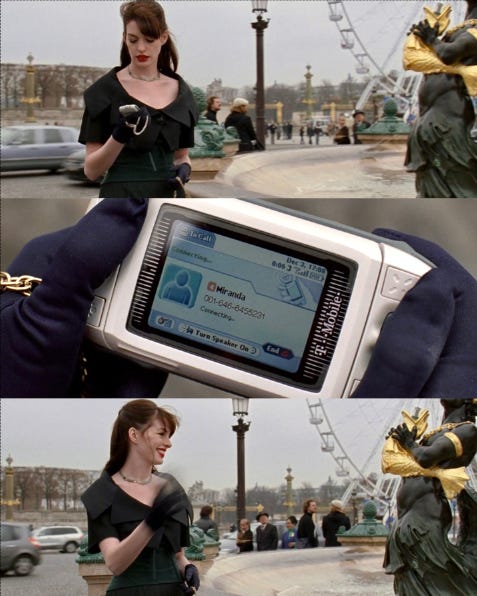
Andy didn’t need a perfect plan to walk away from one of the most coveted jobs in fashion. She needed to get honest with herself about her Point A and Point B.
Your content doesn’t need to be perfect either. It just needs a Point A and Point B.
Start there.
Thanks for reading and have a wonder-full week,
P.S. This newsletter started as a LinkedIn post. A few people found it helpful enough that I turned it into an evergreen post I can point founders to in the future (like my video on Backward Design).